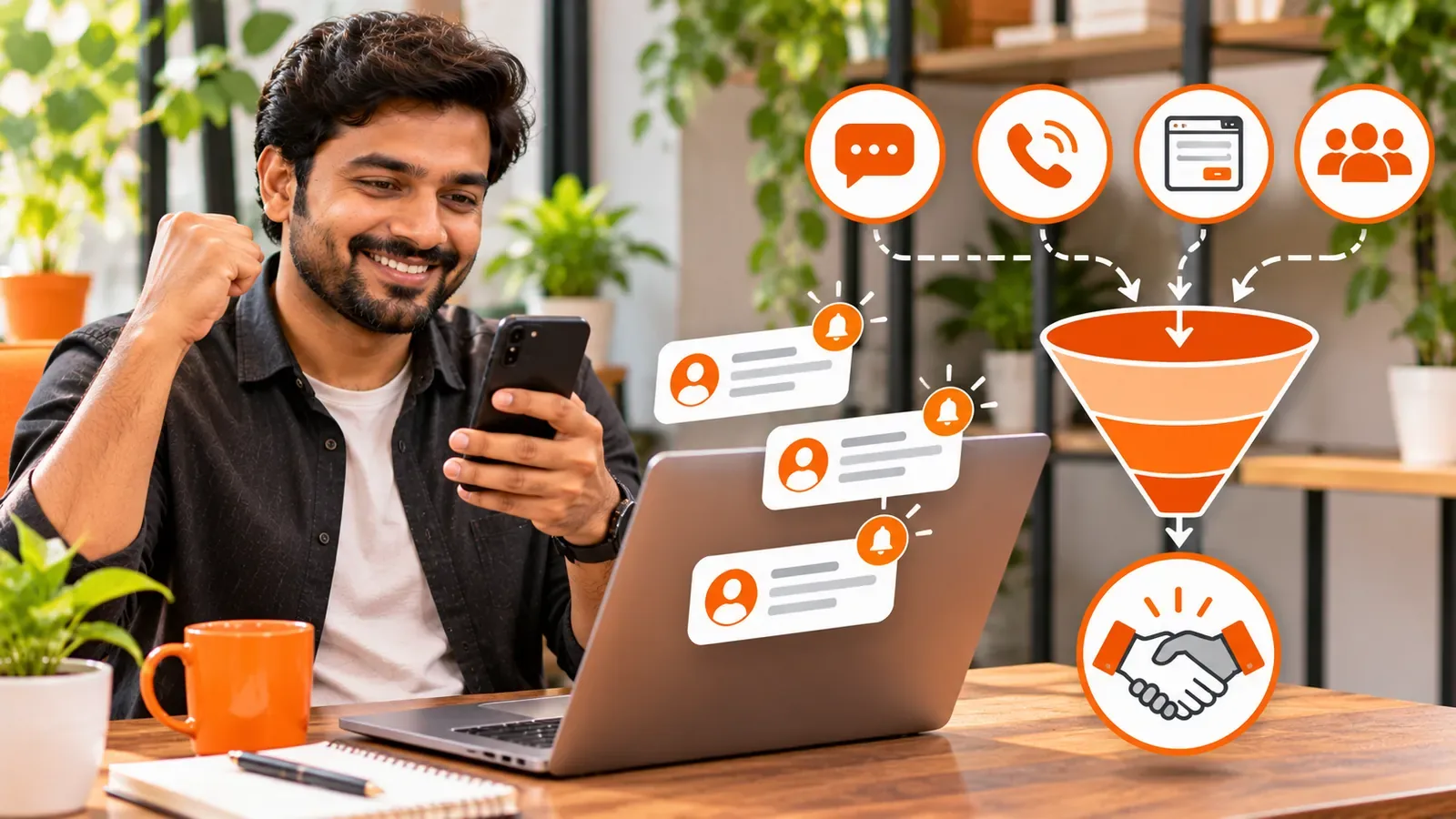
Some months the phone rings constantly. Other months it goes quiet, and you start wondering whether to cut prices, hire a salesperson or try yet another marketing agency. If your enquiries depend on luck, referrals and the occasional boosted post, you don't have a lead problem. You have a system problem.
To get leads for your business consistently, you need three things working together: a place where interested people can find you (search, social or referrals), a clear reason for them to contact you now (an offer), and a fast, organised way to follow up. The most reliable lead sources for small and mid-sized businesses in India are Google Business Profile, Google search (SEO and Google Ads), Meta lead campaigns, referrals and WhatsApp follow-up. Which ones you should start with depends on whether your customers already search for what you sell.
Below I'll walk through the lead generation channels that work, how much effort and money each needs, how to improve lead quality (not just volume), and the follow-up process that turns enquiries into customers. These are the same building blocks behind the 2 lakh+ leads my campaigns have generated over the years.
What counts as a lead, and what's a good one?
A lead is someone who has shown interest and given you a way to contact them: a phone call, a WhatsApp message, a form submission, an email, or a walk-in enquiry.
Not every lead is equal. A useful way to think about it:
- Cold lead: showed light interest, like downloading a free guide or filling a quick form on Instagram without much thought.
- Warm lead: actively compared options, asked about price or availability.
- Hot lead: ready to buy soon, with a clear need, budget and timeline.
Businesses that chase lead volume alone often end up with a sales team calling hundreds of people who never answer. The real goal is qualified leads at a cost your margins can support. Keep that in mind through every channel below.
Start here: does your customer search for you, or do you need to find them?
Before picking channels, answer one question: when someone needs what you sell, do they go to Google and search for it?
- Yes, they search (plumbers, doctors, CAs, coaching institutes, packers and movers, B2B suppliers): your best leads will come from being found. Start with Google Business Profile, SEO and Google Ads.
- No, they don't know to search (new products, lifestyle brands, courses, premium services people haven't considered): you need to reach them first. Start with Meta ads, YouTube, content and partnerships.
Most businesses have a bit of both, but one is usually stronger. Getting this right stops you spending months on the wrong channel.
Lead generation channels that work for small businesses
Here's a quick comparison before we go deeper into each.
| Channel | Speed | Cost | Lead quality | Best for |
|---|---|---|---|---|
| Google Business Profile | Weeks | Free (time) | High | Any local business |
| Google Ads (search) | Days | Pay per click | High | Services people search for |
| SEO | Months | Content and expertise | High | Long-term, low-cost leads |
| Meta lead ads | Days | Pay per lead | Mixed (needs qualifying) | Visual, local and consumer offers |
| Referrals | Ongoing | Low | Very high | Every business |
| Immediate | Low | High (with existing contacts) | Follow-up, repeat customers | |
| Months | Time; ads costly | High for B2B | B2B services | |
| Marketplaces and directories | Days | Subscription or per lead | Mixed, often shared | Testing demand, certain local categories |
1. Google Business Profile: the most underrated lead source
For local businesses, your Google Business Profile often brings more calls than your website. When someone searches "physiotherapist near me", the map results appear above most websites, with call and directions buttons right there.
To turn it into a lead source:
- Choose the most accurate primary category and fill in every field: services, hours, attributes, description.
- Add real photos of your place, team and work every month.
- Ask every happy customer for a review, and reply to every review.
- Post weekly with an offer or update and a clear call to action.
- Use a phone number that's answered, ideally WhatsApp-enabled.
- Tag the website link with UTM parameters so you can track leads from it.
It's free, and in many local categories it's the single highest-return activity available.
2. Google Ads: leads from people actively searching
Google search ads put you at the top of results for chosen keywords, and you pay when someone clicks. The advantage is intent: someone searching "home loan for self employed" or "CCTV installation in Faridabad" is much closer to buying than someone scrolling a feed.
What separates profitable campaigns from money-wasters:
- Tight keywords: focus on searches that show buying intent, not broad research terms.
- Negative keywords: block searches like "jobs", "free", "salary", "course", "DIY" if they don't fit.
- Location targeting: only the areas you can actually serve.
- Matching landing pages: an ad about AC repair should land on an AC repair page, not your homepage.
- Call tracking and conversion tracking: count calls, forms and WhatsApp clicks as conversions, then optimise for them.
- Ad schedule: if nobody answers calls at night, don't pay for clicks at night.
Cost per click varies hugely by industry and city, from a few rupees to several hundred for competitive services like loans, insurance and legal. Start with a test budget, track cost per customer, and scale what works.
3. SEO: leads that keep coming without paying per click
SEO takes longer, usually several months, but leads from organic search don't cost per click. Over time, it can become your lowest-cost lead source.
For lead generation, focus SEO on:
- Service pages for each main service, with clear pricing guidance, process, proof and a strong call to action.
- Location pages for areas you genuinely serve, with real local information, not just the city name swapped.
- Buying-question content: "how much does X cost", "X vs Y", "how to choose a X". People searching these are close to a decision.
- Trust content: case studies, before-and-after examples, team and credentials.
Every SEO page should make it obvious how to contact you: a visible phone number, a WhatsApp button and a short form.
4. Meta lead ads: reach people before they search
Facebook and Instagram ads can put your offer in front of people who match your customer profile, even if they aren't looking yet. Lead ads with instant forms make it easy to respond without leaving the app, which keeps cost per lead low.
The catch is quality. Because the form is so easy, many people submit without much intent, or mistype their number. To improve quality:
- Add one or two qualifying questions, such as budget range, location, or timeline.
- Use the "higher intent" form option, which adds a review step before submitting.
- Be specific in the ad about price ranges or eligibility, so unsuitable people self-select out.
- Call or WhatsApp leads within minutes, while they still remember the ad.
- Feed back which leads became customers (through the Conversions API or offline conversions) so Meta can find more like them.
Alternatively, send traffic to a landing page or to WhatsApp instead of an instant form. You'll usually get fewer leads, but often better ones.
5. Referrals: your highest-quality leads
Referred leads trust you before the first conversation, close faster and argue less on price. Yet most businesses leave referrals to chance.
Make it a system:
- Ask for referrals at the moment of greatest satisfaction, such as project completion, a great result, or a thank-you message.
- Make it easy: a short WhatsApp message they can forward, or a simple referral link.
- Thank referrers personally, and consider a small, appropriate reward where it fits your industry and rules.
- Build referral partners: businesses that serve the same customers but don't compete. An architect and an interior contractor, a CA and a lawyer, a gym and a physiotherapist.
6. WhatsApp: the follow-up channel India actually uses
In India, many customers prefer to message rather than call or fill forms. WhatsApp works as both an entry point and a follow-up tool.
- Add a click-to-WhatsApp button on your website, Google profile and ads.
- Use WhatsApp Business features: catalogue, quick replies, labels for lead stages, and away messages.
- For larger volumes, the WhatsApp Business Platform (via an approved provider) supports automated replies, broadcasts to opted-in contacts, and integration with your CRM.
- Send useful follow-ups, not spam: answers to common questions, a short video of your work, a reminder of the offer.
Only message people who've contacted you or opted in. Unsolicited bulk messaging annoys people and can get your number restricted.
7. LinkedIn: for B2B leads
If you sell to businesses, LinkedIn is where decision-makers spend professional time. The founder's personal profile usually outperforms the company page: posts that share real lessons, client results (with permission) and opinions about the industry build visibility with the right people. Follow up with considered, personalised messages, not copy-pasted pitches. LinkedIn ads work but are expensive; test them once your offer and targeting are proven elsewhere.
8. Marketplaces and directories
Platforms like Justdial, Sulekha, IndiaMART, Practo or UrbanCompany can bring leads quickly in certain categories. Leads are often shared with several competitors, so speed of response and pricing matter a lot. Treat them as a supplement and a way to test demand, not your only source, because you don't own the customer relationship and costs can rise without warning.
9. Content and video: leads that build trust before the first call
Content works slower than ads but pre-sells people. Someone who has watched three of your videos explaining how a home loan works, or read your guide on choosing a school, arrives already trusting you. These leads tend to ask fewer basic questions and push back less on price.
- Short videos on Instagram and YouTube Shorts answering one customer question each: "How long does a root canal take?", "What does GST registration cost?"
- Longer YouTube videos for complex or high-value services, where people want to see who they'll be dealing with.
- Guides on your website that rank for buying questions and end with a clear next step.
- Customer stories with permission: the problem, what you did, the result.
Every piece of content should end with one clear action, such as a WhatsApp link, a booking link or a phone number. Content without a next step builds an audience, not a pipeline.
10. Offline still counts
Digital doesn't replace everything. Local events, workshops, trade fairs, society tie-ups, and printed QR codes on shopfronts, delivery bags and invoices still produce leads, especially in smaller cities. The trick is to connect them to your digital system: a QR code that opens WhatsApp with a pre-filled message, or a short link to a landing page, so offline interest gets tracked and followed up like any other lead.
Lead generation ideas by industry
These are starting points. Your own customer research should refine them.
Clinics and healthcare
Google Business Profile with steady reviews, service pages for each treatment, Google Ads for high-intent treatment searches, and Instagram content showing the doctor and the clinic. Online appointment booking and WhatsApp reminders reduce no-shows. Be careful with claims: healthcare advertising has stricter rules on platforms and under Indian regulations.
Coaching institutes and education
Meta lead ads around admission seasons with qualifying questions (class, subject, location), free demo classes as the offer, results and testimonials from past students with consent, and fast callback within minutes. Google Ads for "coaching for X near me" searches.
Real estate
Meta and Google lead campaigns with budget and location questions, project walkthrough videos, WhatsApp brochures and site-visit booking. Expect lower lead-to-customer rates, so lead qualification and persistent follow-up matter most.
Home services (AC repair, plumbing, pest control, interiors)
Google Business Profile and Google Ads for "near me" searches, clear starting prices, before-and-after photos, and quick WhatsApp quotes from photos customers send. Seasonal pushes work well: AC servicing before summer, waterproofing before monsoon.
B2B manufacturers and service firms
Detailed product and capability pages for SEO, IndiaMART or industry directories as a supplement, LinkedIn for founder and sales visibility, and Google Ads for specific product searches. Case studies and quick, technical responses to RFQs win deals.
D2C and ecommerce
Here a "lead" is often a subscriber or a first purchase. Meta ads with strong creatives, a first-order offer captured by email or WhatsApp sign-up, abandoned-cart reminders, and user-generated content for trust.
Turn visitors into leads: the conversion basics
Traffic without conversion is just numbers. Before spending more on any channel, check that people who arrive can easily become leads.
Make contacting you effortless
- Phone and WhatsApp buttons visible on every page, especially on mobile
- Forms with as few fields as possible: name, phone and what they need is often enough
- A clear next step: "Book a free consultation", "Get a quote in 2 hours", "Check availability"
Give a reason to act now
An offer lowers the risk of making contact. Free inspection, free first consultation, a price estimate within hours, a limited festival discount. The offer should be genuinely useful and honest, never a fake countdown.
Prove you're trustworthy
Google reviews embedded on the page, photos of your real team and work, client logos, years in business, certifications, and specific results. Many Indian customers are wary of being cheated online. Proof answers that worry before they voice it.
Use lead magnets for longer decisions
For B2B or high-value purchases, people often aren't ready to talk on the first visit. A useful free resource, such as a price guide, checklist, calculator or short report, lets them raise their hand early. Then you follow up with more help, not pressure.
How many leads do you actually need?
Work backwards from revenue instead of guessing. Say you want ₹5,00,000 in new monthly revenue and your average sale is ₹25,000. You need 20 customers. If your team closes about one in six leads, you need roughly 120 leads a month. If you close one in three, you need only 60.
That simple calculation shows two levers, not one. You can generate more leads, or you can convert more of the leads you already have through better offers, faster follow-up and stronger proof. Improving your close rate from one in six to one in four cuts the leads you need by a third, often without spending a rupee more on ads. Most businesses only pull the first lever.
Speed to lead: why follow-up decides everything
Here's the uncomfortable truth: many businesses don't have a lead generation problem. They have a follow-up problem. Leads come in, and someone calls back the next day, or the day after, by which time the customer has already spoken to two competitors.
A follow-up process that works:
- Respond within minutes during business hours. Set up instant notifications for every new lead, by email, WhatsApp or app.
- Use an automatic first reply outside hours, so the lead knows you received it and when you'll call.
- Call first, then WhatsApp. If they don't pick up, send a short message with your name and purpose.
- Try several times over a few days. Many leads convert on the second or third contact, not the first.
- Record every lead and its outcome in a sheet or CRM: source, date, status, reason lost.
- Nurture the ones not ready yet with occasional, useful messages.
Fixing response time is often the cheapest way to get more customers from the leads you already pay for.
How to measure lead generation properly
Track these numbers by channel, monthly:
| Metric | Formula | Why it matters |
|---|---|---|
| Cost per lead (CPL) | Spend ÷ leads | Efficiency of getting enquiries |
| Lead-to-customer rate | Customers ÷ leads | Lead quality and sales effectiveness |
| Cost per acquisition (CPA) | Spend ÷ customers | The real cost of a new customer |
| Customer value | Average profit per customer over time | How much you can afford to spend |
| Response time | Time from enquiry to first contact | Hidden driver of conversion |
The channel with the cheapest leads is not always the best. If Meta gives you ₹150 leads but only one in 40 buys, while Google gives ₹600 leads and one in six buys, Google is far cheaper per customer. Always compare cost per customer.
A simple 30-day plan to get more leads
Week 1: Fix the leaks
- Add visible call and WhatsApp buttons to your website
- Shorten forms; add a clear offer to key pages
- Set up instant lead notifications and a lead tracking sheet
- Agree who responds to leads and how fast
Week 2: Strengthen what's free
- Complete your Google Business Profile and upload fresh photos
- Send review requests to recent customers
- Message past happy customers asking for referrals
Week 3: Launch one paid channel
- Google Ads if customers search for you; Meta lead ads if they don't
- Small test budget, conversion tracking set up from day one
- Landing page that matches the ad
Week 4: Review and adjust
- Check cost per lead, lead quality and response times
- Pause what isn't working; improve the best ad and page
- Plan SEO content for your top-converting services
Lead generation mistakes to avoid
- Buying lead lists or databases. Usually outdated, often without consent, and cold messaging them damages your reputation and may break data protection rules.
- Judging channels by cost per lead alone. Look at cost per customer.
- Sending all traffic to the homepage. Match the page to the offer.
- No qualifying questions. Your sales time gets eaten by people who were never going to buy.
- Slow or inconsistent follow-up. The most expensive mistake on this list.
- Relying on one platform. If one channel or marketplace changes its rules, your pipeline shouldn't collapse.
- Fake urgency or exaggerated claims. They may increase leads briefly but destroy trust and reviews.
Getting help with lead generation
You can put most of this in place yourself. Where outside help pays off is in setting up tracking properly, running paid campaigns profitably, and building SEO that brings leads for years. If you want an honest look at where your leads should come from, and where they're currently leaking, tell me about your business. I'll personally reply with what I'd fix first.
Written by Aman Potlia.